Digital Logic Simulator
Design, simulate, and export digital circuits — right in your browser.
1 + 0 = 01(binary: carry, sum)
Click A or B to flip an input
Open a working circuit in one click
Every example loads straight into the editor — flip inputs, rewire, break it, and see what happens.
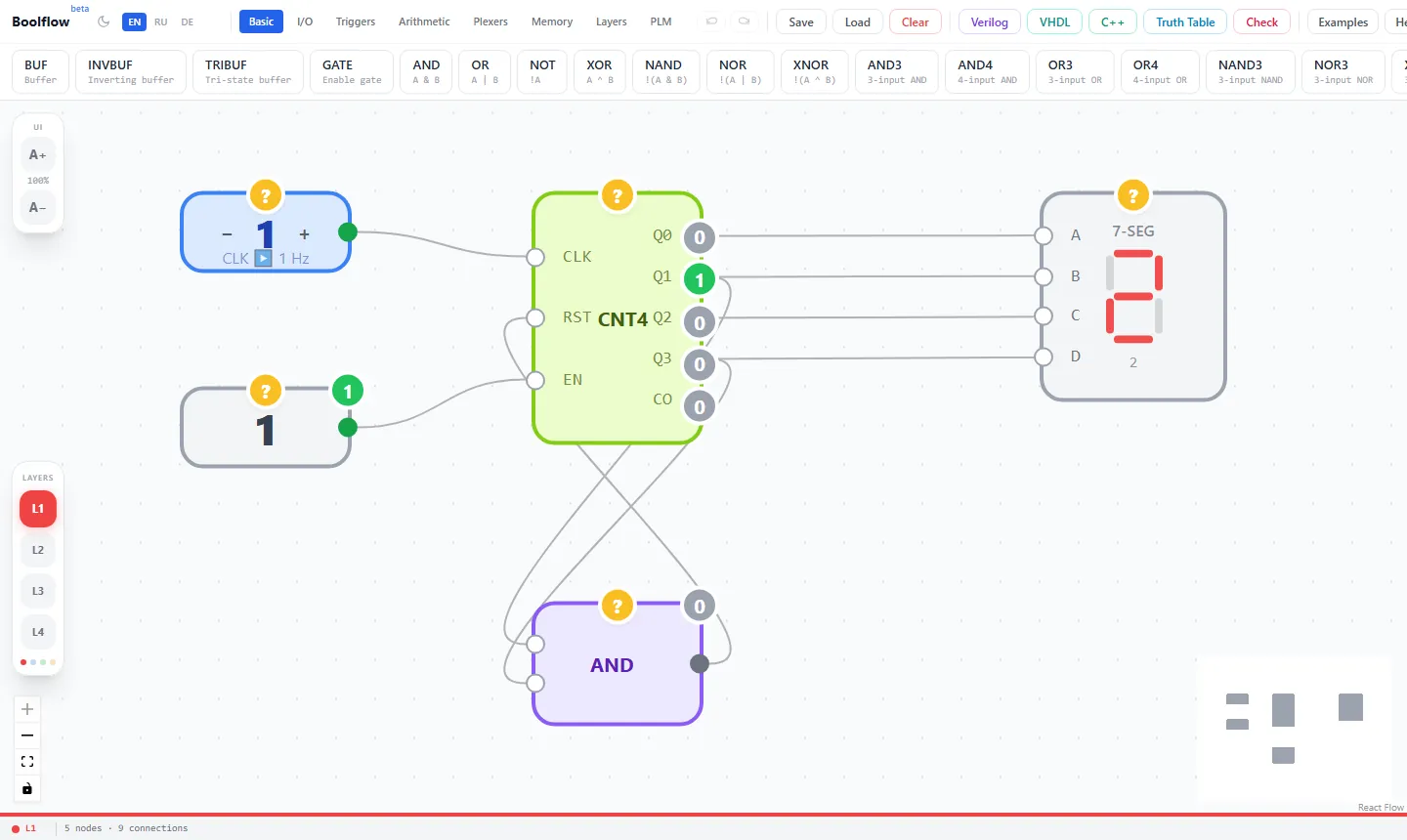
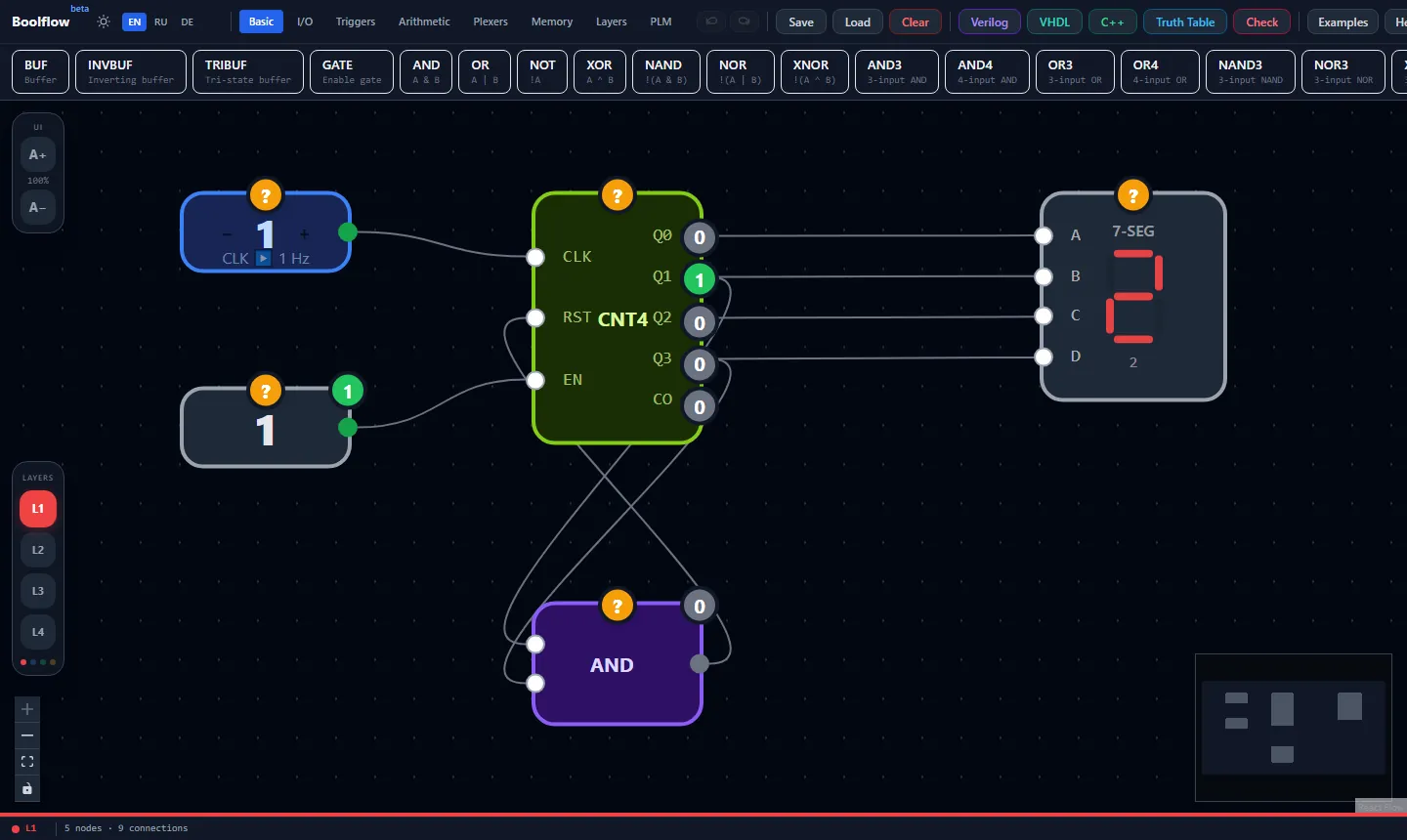
Decade counter
A 4-bit counter reset at 10 — counts 0–9 on a 7-segment display.
4-bit LFSR
A shift register feeding itself through a gate — 15 pseudo-random states.
Serializer (UART core)
A parallel word goes in, one bit per clock comes out — the heart of serial communication.
4-bit adder
Four full adders chained by carry — adds two 4-bit numbers.
ALU
Add, AND, OR, XOR, chosen by two select bits.
Tri-state bus
Two drivers share one wire — enable one at a time.
Your circuit becomes real code
One click turns what you drew into Verilog, VHDL or C++ — with your own signal names and an optional testbench.
- ✓Signal names come from the labels you typed on the canvas
- ✓The C++ output compiles as it is — a plain function, no simulator needed
- ✓Check the design first: truth table and test cases
// Generated by BoolFlow module boolflow ( input wire A, input wire B, output wire SUM, output wire CARRY); // Internal wires wire w_x_0; wire w_n_0; // XOR assign w_x_0 = A ^ B; // AND assign w_n_0 = A & B; assign SUM = w_x_0; assign CARRY = w_n_0; endmoduleEverything you need to explore digital logic
70+ gates and elements
From AND and XOR to counters, adders, ALUs and programmable PLM blocks — all ready to place.
Real-time simulation
Click any INPUT — signals update across the whole circuit instantly.
Truth table
The complete table for any combinational circuit, generated automatically.
Multi-layer design
Up to 4 independent layers linked by VIA nodes keep big circuits readable.
Test cases and checks
Write the outputs you expect, run them in one click, and catch a loose wire before it costs you an hour.
Who Boolflow is for
Check your homework instead of copying it
Build the circuit from a lab assignment, flip the inputs and compare the result with your truth table. A test case tells you exactly which row fails.
Show it live in class
Open an example, click the inputs and let the room watch the signals travel. Every example opens from a link, so students get the exact same circuit.
Prototype before you write HDL
Sketch a design and watch it run. Combinational logic exports to Verilog, VHDL or C++, so you do not type it from scratch.
Learn the theory
Boolean algebra and digital logic, explained — with live examples you can build yourself.
Karnaugh Maps for Circuit Simplification
A visual technique for minimizing Boolean expressions by grouping adjacent 1s in a grid — fewer gates, faster and cheaper circuits.
Read →Linear-Feedback Shift Registers
How feeding a shift register's own bits back through XOR gates produces a long pseudo-random sequence — the same trick behind PRNGs and CRC checksums.
Read →Worked Example: A Traffic Light Controller
A complete, concrete finite state machine — three states, one register, one block of combinational logic — built the same way any real Moore machine is.
Read →Questions, answered
Is Boolflow free? Do I need an account?
It is free. There is no account and no sign-up, and nothing to install: the editor runs in your browser. Circuits are saved as .boolflow.json files that stay with you.
Can it simulate flip-flops, counters and feedback?
Yes. D, JK, T and SR flip-flops, registers, shift registers and counters are built in. Circuits with feedback, such as ripple counters and LFSRs, are simulated tick by tick from a CLOCK element, the way hardware behaves.
Which languages can I export to?
Verilog, VHDL and C++. The export covers combinational logic: gates, adders, multiplexers and the like. Flip-flops, registers and counters are skipped, and every skipped element is marked in the output, so nothing disappears silently.
How do I check that my circuit is correct?
For a combinational circuit Boolflow builds the truth table by itself, and you can write test cases, which are the outputs you expect for given inputs, and run them with one click. A circuit with flip-flops you check by running it and watching the outputs.
Does it work on a phone or tablet?
Yes. Touch is supported: tap one pin, then another, to connect them. Big circuits are still more comfortable on a larger screen.
Where can I learn the theory behind it?
In the Articles section: Boolean algebra, Karnaugh maps, flip-flops, counters and state machines, in English, Russian and German. Most articles come with a diagram and a circuit you can open in the editor.
Ready to start designing?
No install. No account. Just open the editor and start placing gates.
- ✓Free
- ✓No sign-up
- ✓Runs in your browser